
- All
- Arbitration Law
- Banking Law
- Capital Markets and Securities Law
- CBCL - LSPR Series
- Commercial Courts Act
- Commercial Law
- Company Law
- Competition Law
- Contemporary Issues
- Contract Law
- Corporate Governance
- Debt Recovery
- Employment Law
- Energy Laws
- Foreign Direct Investment Regulations
- Guest Posts
- Insolvency Law
- Intellectual Property Law
- Investment Law
- Mergers & Acquisitions
- Promotion
- Sports Law
- Taxation Law
- Technology Law
- Trade Law
- Uncategorized
- Back
- Kaizen

[By Parth Tyagi and Achyutam S. Bhatnagar] The authors are third year students of NLIU Bhopal and NLU Orissa respectively. Meaning and Provisions of Corporate Social Responsibility The list of activities comprising Corporate Social Responsibility (“CSR”) in Schedule VII of the Companies Act, 2013 (hereinafter “the Act”) is inclusive and not exhaustive as it contains the phrase “such other matters as maybe prescribed”. However it does not give…

[By Arnav Maru] The author is a fourth year student of MNLU Mumbai. Recently in 2019, both houses of the Parliament passed a Bill to amend the Arbitration and Conciliation Act, 1996 (“the Act”). While the Bill is a successor to its 2018 counterpart, it comes with minimal additions and improvements. This blog post focuses on the amendment sought for section 34 of the Act. Section 34 deals…

[By Anshritha Rai] The author is a fifth year student at ILS Law College Pune. In a recent landmark decision of Supreme Court in the case of Gammon Engineers and Contractors Pvt. Ltd. v. NHAI [i], it was held that where the arbitrators’ fee is already fixed by agreement, section 31(8) of the Arbitration and Conciliation Act, 1996 (hereinafter “the Act”) is inapplicable. Section 31(8) of the Act provides power…

[By Saumitra Shrivastava] The author is a fifth year student of NLU Raipur. Introduction The issue of arbitrability of intellectual property rights (hereinafter “IPR”) disputes has always been a subject of great speculation and interest. This is partially because of the massive role of IPR in the world of commerce which eventually leads to a significant number of disputes. For a healthy functioning economy, it is imperative to…

[By Prerna Kapur] The author is a fifth year student of National Law University, Orrisa. Background The Competition Commission of India (“CCI”) vide order dated 28.02.2019 dismissed the allegations against one of India’s largest multiplex chains, Inox Leisure Ltd. and its beverage partner, Hindustan Coca-Cola Beverages Private Limited (“parties”). The allegations concerned contravention of provisions prohibiting tie-in arrangement, exclusive supply and distribution agreements under Section 3(4)(a), 3(4)(b), and…

[By Rahul Kanoujia and Venkata Supreeth Kesapragada] The authors are third year students of Gujarat National Law University, Gandhinagar. Introduction In the present case [i], the appellants, Ssangyong Construction Co. a construction company registered under the laws of the Republic of Korea, entered into a contract with the respondent National Highways Authority of India (“NHAI”) a government undertaking overseeing the construction of highways across the territory of India.…

[By Deeksha Gabra and Shivam Gupta] Deeksha is a Chartered Accountant and Shivam is a fifth year student of RGNUL, Punjab 1. Background Shares with Differential Voting Rights (hereinafter “DVR Shares”), also known as Dual Class Shares internationally, are shares with rights disproportionate to their economic ownership. The concept of DVR is not new to India. It can be traced back to 2000 when the then Companies Act,…
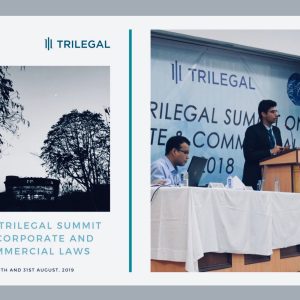
(Ishaan Chopra is fourth year student at NLIU, Bhopal and can be reached at [email protected]) Last year, in July 2018, the Centre for Business and Commercial Laws (CBCL) announced the prizes for the 4th NLIU-Trilegal Summit on Corporate and Commercial Laws. My mind processed and captured three pieces of information from the poster put up by CBCL – a paid foreign trip, an internship at Trilegal and an…